By John Dylan Barker, Atlas High Performance Homes
Summary: Most of the cold-weather problems I am called to fix in New Hampshire homes start with air leaking through the house, not with too little insulation. This article explains how that air carries heat and moisture into attics and walls, what the New Hampshire energy code allows, and the order in which air sealing should be done.
The Problem: Drafty Rooms, Ice Dams and Wet Attics
Homeowners call me about symptoms. A bedroom over the garage never warms up. Frost collects on the roofing nails in the attic. Ice dams keep forming even after more insulation was blown in.
Those problems often continue after a homeowner adds insulation or replaces the roofing. The companion article, Why Choose Atlas for Air Sealing in New Hampshire, describes one of those houses: a vaulted ceiling under a standing-seam metal roof that leaked at the seams.
The Cause: Air Carries Heat and Moisture Through Leaks
The Builder's Guide to Cold Climates by Joseph Lstiburek of Building Science Corporation ranks the four control layers of a building in order of importance: water, air, vapor and thermal (p. 50). Air comes before insulation for a reason. As Building Science Corporation's air barrier digest BSD-104 puts it, airflow "merits major consideration mainly because of its influence on heat and moisture flow."
The Stack Effect
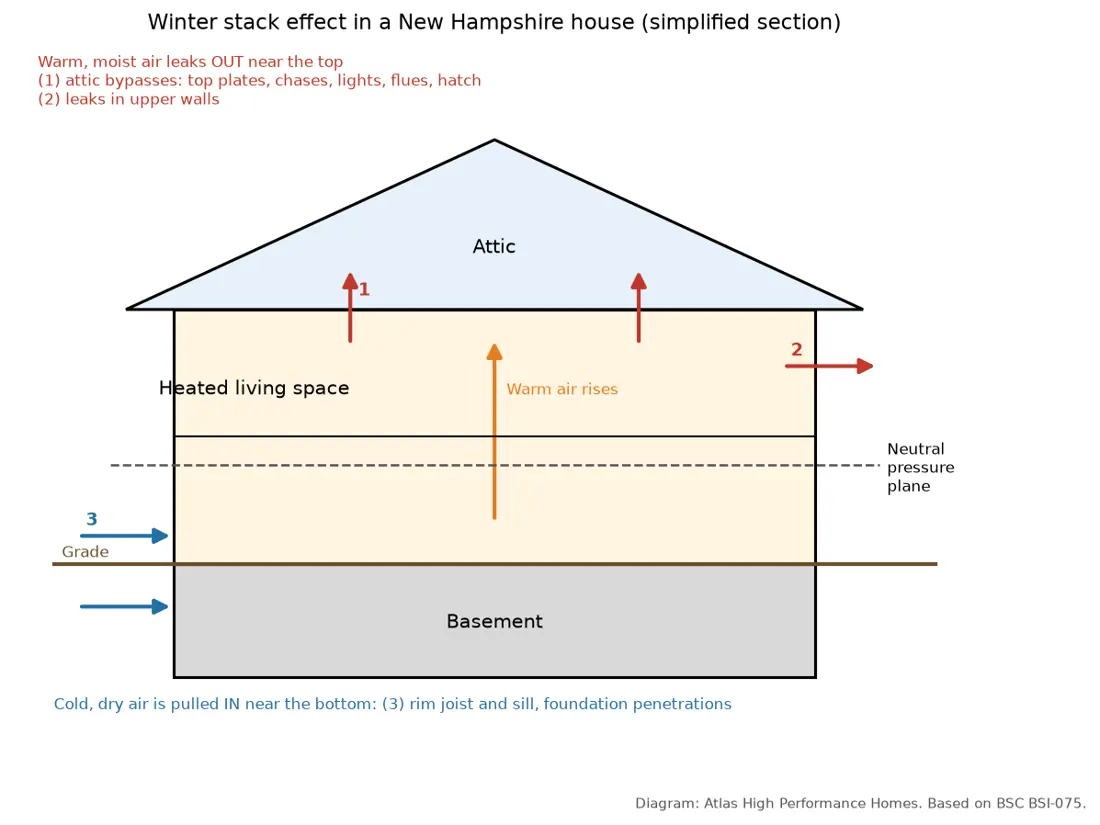
In winter, heated air inside the house is lighter than the cold air outside. It rises and pushes out through leaks near the top of the house. The same force pulls cold outdoor air in through leaks near the bottom. This is called the stack effect.
The height where the pressure changes from pushing air out to pulling air in is called the neutral pressure plane (BSI-075). Leaks above it lose heated air. Leaks below it let cold air in.
What the Escaping Air Carries
The air leaving through the top of the house carries indoor moisture with it. The guide gives a direct comparison for Chicago, which is in climate zone 5 like southern New Hampshire. Over a winter, a 1-inch square hole moves 100 times more water vapor into a wall than diffusion through a 32-square-foot sheet of painted drywall (p. 136).
That moisture condenses on cold attic sheathing and on the back of wall sheathing. The heat that leaves with it warms the roof deck and melts the snow on top. The meltwater runs down to the cold eaves, refreezes and forms an ice dam. The guide names "the elimination of air movement, particularly exfiltrating air in cold climates" as the main strategy for roofs free of moisture problems and ice dams (p. 221).
This is why more insulation alone often fails. Air passes through fiberglass and cellulose, so the leaks underneath stay open.
What the New Hampshire Energy Code Allows
New Hampshire uses the 2018 International Energy Conservation Code (IECC) with state amendments. The model 2018 IECC limits new homes in climate zones 3 through 8 to 3 air changes per hour at 50 pascals (ACH50) on a blower door test.
New Hampshire adopted the 2024 IRC effective July 1, 2026 (HB 1159); either the 2021 or 2024 edition may be used for permits through Dec 31, 2026, and the 2024 edition is required from Jan 1, 2027. Energy rules remain the 2018 IECC with NH amendments.
New Hampshire amended that limit to 5 ACH50, so a new home here can be about two-thirds leakier than the model code allows. A signed test report goes to the code official (NH Building Code Review Board amendments, Section R402.4.1.2).
Under 2024 International Residential Code Section R325.3, a home built to the code's air-leakage requirements must have mechanical ventilation in accordance with Section M1505, or other approved ventilation [VERIFY: 2024 IRC section R325.3 trigger; it points to N1102.5.1, and NH replaced Chapter 11 with the 2018 IECC as amended]. That is a reason to ventilate, not a reason to stop sealing. As the guide states, "Buildings can never be built too tight. However, they can be under-ventilated" (p. 400).
Who Should Do the Work
Air sealing touches almost every part of a house, from the foundation to the roof, so it works best when one contractor is responsible for the whole enclosure. That is how we work at Atlas. Our materials, testing and pricing are covered in Why Choose Atlas for Air Sealing in New Hampshire.
The Solution: Seal in the Right Order, Then Ventilate
The guide's rule is to build "tight and then ventilated right," because "before you can control air you must enclose it" (p. 43). The order below applies to any New Hampshire house.
1. Test first. A blower door test measures how leaky the house is in ACH50. An infrared camera used during the test shows where the air is getting through.
2. Seal the top and bottom of the house. That is where the stack effect pushes hardest.
| Location | Typical leaks | How to seal them |
|---|---|---|
| Attic floor | Top plates, plumbing and wiring holes, recessed lights, attic hatch | Sealant and foam at plates and holes, airtight-rated light fixtures, gasketed and insulated hatch |
| Chimney and flue chases | Open gaps around the chase | Sheet metal and high-temperature sealant |
| Ducts in the attic | Leaky joints and air handlers | Mastic on joints, or move ducts inside the heated space |
| Rim joist and sill | Gaps between foundation, sill plate and floor framing | Sealant at the sill and rim, then insulation over it |
The guide identifies leaky ducts and air handlers in vented attics as "the single largest cause of ice dams" (p. 42), so the duct row should never be skipped. It also calls for close attention to rim joists, floors over garages and cantilevers (p. 334, 355–356).
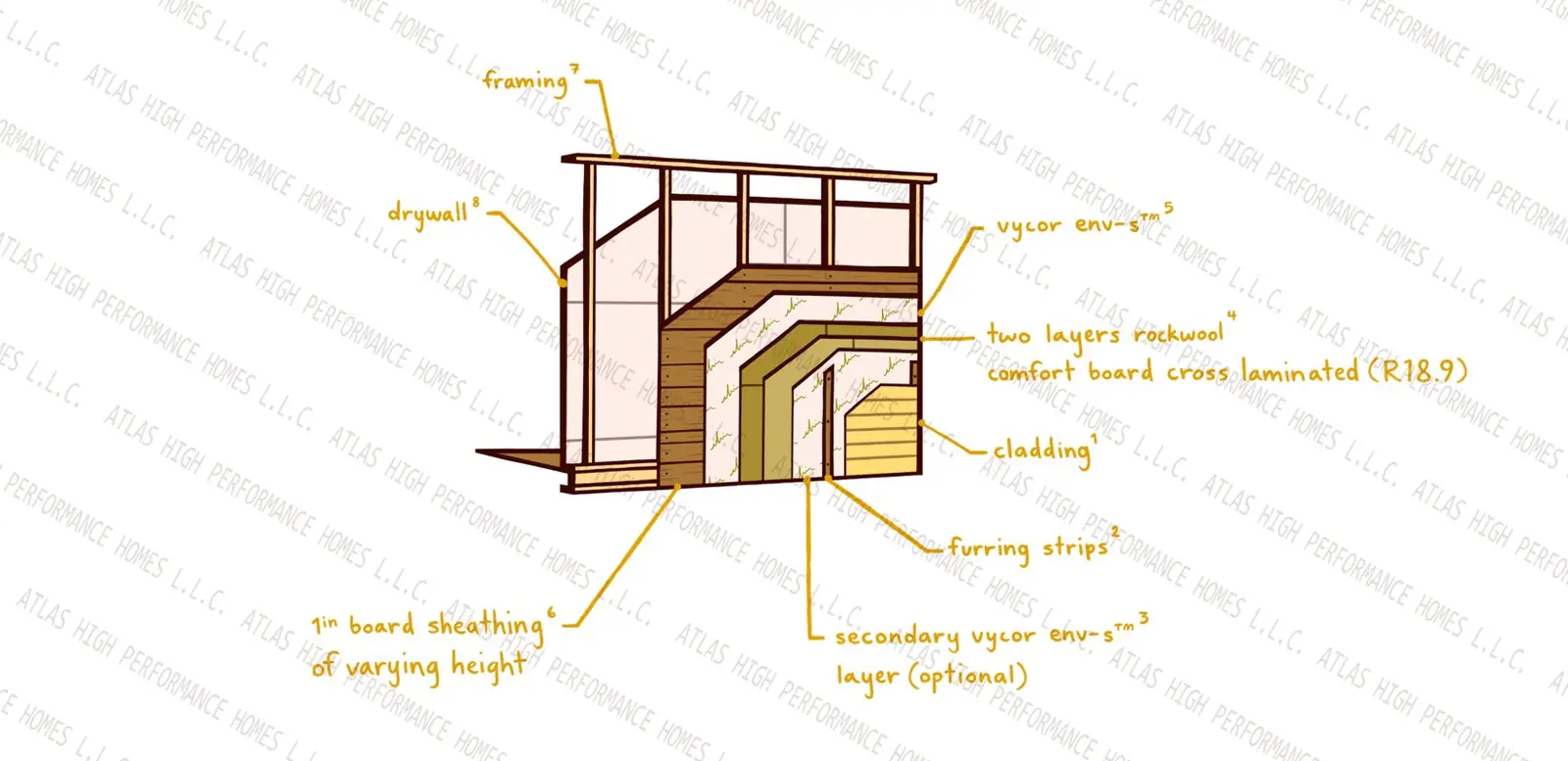
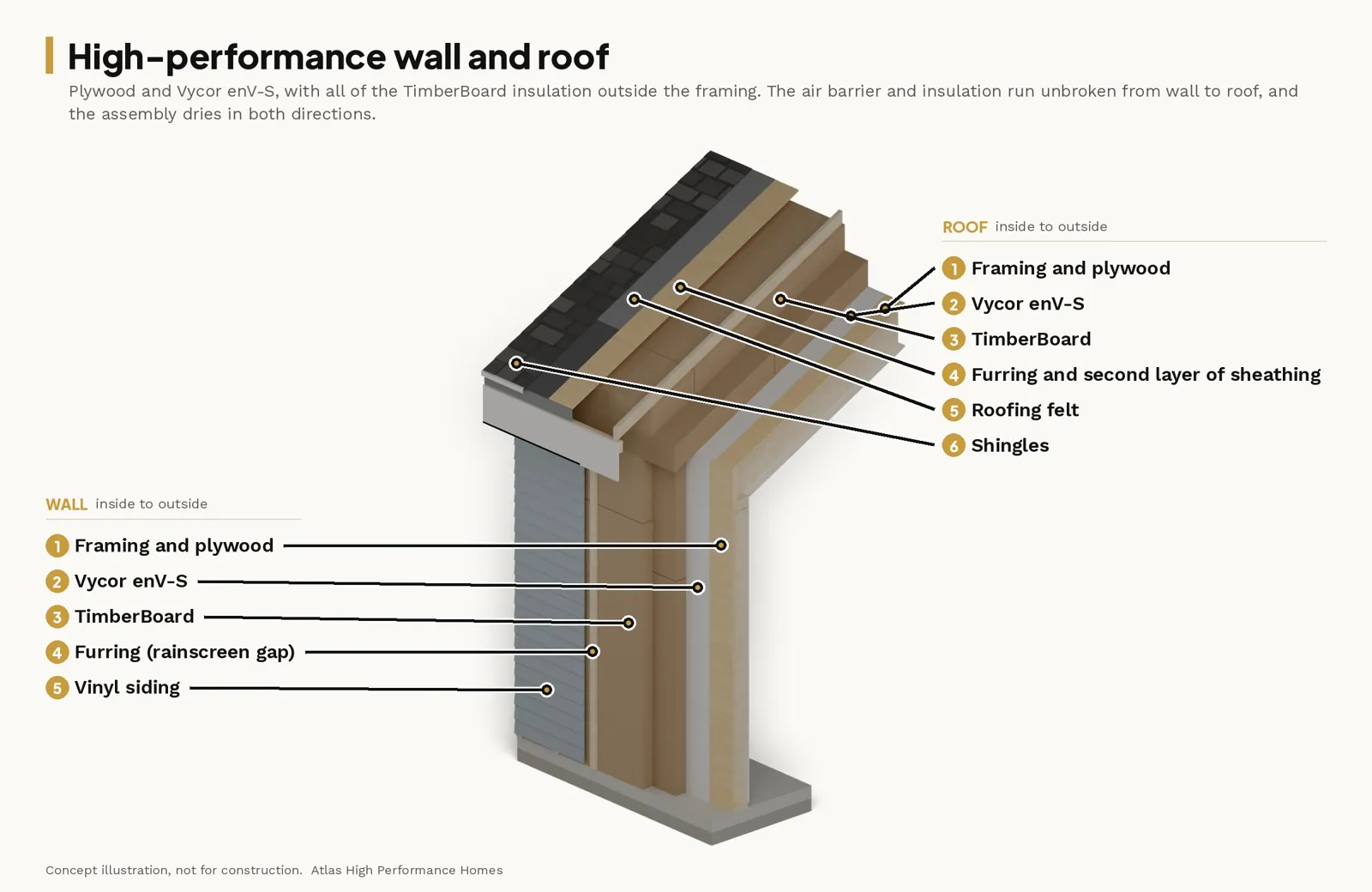
3. Add a continuous air barrier when the walls or roof are open. Re-siding, re-roofing and new construction expose the sheathing. That is the best time to install an air barrier on the outside of it. The guide requires an air control layer to be impermeable to air flow, continuous over the entire building enclosure, able to withstand the forces acting on it, and durable over the life of the building (p. 101).
4. Add controlled ventilation. A balanced system, such as an energy recovery or heat recovery ventilator, supplies fresh air at a steady rate. The guide recommends balanced ventilation (p. 298) and only sealed-combustion or power-vented appliances inside the house (p. 409).
5. Then add insulation. With the leaks closed, insulation performs at its rated value.
What Air Sealing Saves
The U.S. Environmental Protection Agency models average heating and cooling savings from air sealing plus attic and basement insulation at 16% in climate zone 5 and 18% in climate zone 6 (ENERGY STAR methodology). Under the 2018 IECC as amended in New Hampshire, the southern counties are climate zone 5 and the northern and central counties are zone 6. A state amendment effective July 1, 2026 (EN-18-17-25) moved Merrimack County from zone 6 to zone 5. Confirm the zone for your town with the building official.
Note: These savings figures are modeled national estimates. Actual savings depend on how leaky the house is to start, how it is heated and what other work is done at the same time.
Next Step
Reach out if you are interested in air sealing your home or have any questions!
Atlas High Performance Homes
Phone: (603) 688-6096
Email: AtlasRemodelingNH@gmail.com
Sources
- Lstiburek, J. Builder's Guide to Cold Climates. Building Science Corporation, 2022, pp. 42, 43, 50, 101, 136, 221, 298, 334, 355–356, 400, 409.
- Building Science Corporation, BSD-104: Understanding Air Barriers.
- Building Science Corporation, BSI-075: How Do Buildings Stack Up?
- New Hampshire Building Code Review Board, State Building Code Amendments with errata, July 2026, IECC R402.4.1.2.
- International Code Council, 2024 International Residential Code, Section R325.3.
- ENERGY STAR, Methodology for Estimated Energy Savings.