By John Dylan Barker, Atlas High Performance Homes
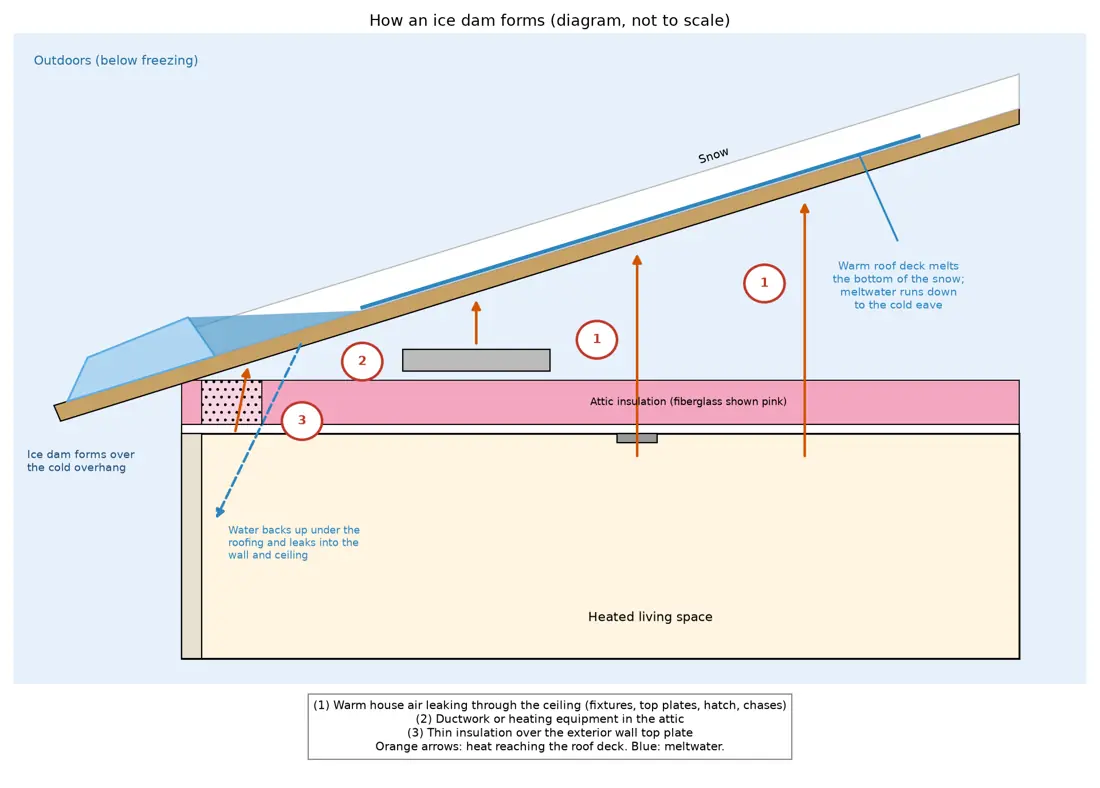
Summary: An ice dam forms when heat from the house warms the roof deck, melts the snow on it, and the water refreezes at the colder eave. Heat cables and roof rakes deal with the ice or snow, not the heat. Ice dams are prevented by sealing and insulating the ceiling, keeping the roof deck ventilated and, when the roof is replaced, building it so the deck stays cold.
The Problem: A Leak That Looks Like a Roof Problem
The water usually shows up during a thaw after a cold, snowy stretch: a stained ceiling near an exterior wall, or a drip at the top of a window. Outside, a ridge of ice runs along the roof edge.
John Straube of Building Science Corporation (BSC) explains that the ice ridge traps meltwater that leaks "under and through the roofing," damaging "the sheathing, the roof structure, or the ceiling and walls below" (BSD-135). Because the water comes through the roof, many homeowners replace the roofing, and the ice dams come back.
The Cause: Heat Reaching the Roof Deck
Joseph Lstiburek of BSC states the conditions plainly: ice dams happen "when the outside temperature is below freezing, the roof deck temperature is above freezing, and there is snow on the roof" (BSI-046). The overhang sits over the outdoors and stays below freezing, so the meltwater refreezes there.
The heat comes from the house. In BSD-102, Lstiburek writes that it "is typically a combination of air leakage and conductive losses." The common sources are:
- Air leaks through the ceiling. Warm air rises and escapes through fixtures, wiring and plumbing holes, top plates, the hatch and chases. Lstiburek: "airtightness is more important than insulation levels. But both are important."
- Ducts and heating equipment in the attic. His Builder's Guide to Cold Climates calls this heat loss "the single largest cause of ice dams" (p. 42).
- Thin insulation over the exterior walls, where the roof comes down low.
Snow also insulates the deck, at about R-1 per inch according to Lstiburek, so deeper snow means more melting.
Why Heat Cables, Roof Rakes and More Vents Are Not Enough
| Measure | What it does | What it does not do |
|---|---|---|
| Heat cables | Melt a path through the ice at the edge | Stop heat from warming the deck. The Minnesota Department of Commerce advises against them: "They will shorten the life of your roof and add to your energy costs." |
| Roof rake | Removes snow, so less can melt | Last past the next storm. University of Minnesota Extension notes that raking "may damage the roofing materials." |
| Steaming the ice | Clears an active dam without chipping | Change why the dam formed |
| Membrane under the whole roof | Keeps backed-up water out longer | Prevent the ice dam. Lstiburek: it "only limits the damage." |
Adding roof vents or an attic fan before sealing the ceiling is a common mistake. Straube writes that "adding ventilation openings is likely to increase the problem by allowing the leaking air more easy access to the outdoors," and University of Minnesota Extension does not recommend mechanical attic ventilation for ice dams.
How I Approach Ice Dams at Atlas
Atlas does not steam or remove ice dams. If water is coming in now, call an ice dam removal company that uses steam, and stay off the roof; Lstiburek notes that people die every year from falling ice or falls while clearing it.
What we do is find out why the dams form and fix that. As a licensed New Hampshire home inspector, I start with a building science assessment with a blower door test and an infrared scan, to trace where the water entered and where the heat is leaving. Our crew then does the air sealing and insulation, and a second test shows how much the leakage dropped. Once the cause is fixed, we repair the damaged drywall, insulation and sheathing.
The Solution: Fix It in This Order
1. Find the heat leaks. A blower door test with an infrared scan in cold weather shows them. Bare patches in the roof snow also point to a source.
2. Seal the ceiling. Seal the top plates, wiring and plumbing holes, light fixtures and fan housings, the hatch, and chases, using noncombustible material at chimneys and flues. Air Sealing First explains why sealing comes before insulation.
3. Get heat sources out of the attic. Every exhaust fan should vent outdoors, as covered in Frost in the Attic. Ducts belong in heated space; if they must stay, the Building America Solution Center recommends sealing them and burying them in the insulation (Construct Roofs and Attics for Ice Dam Prevention).
4. Insulate. New Hampshire's energy code (the 2018 IECC with state amendments) requires R-49 in the ceiling of a new home in both of the state's climate zones, 5 and 6. The Solution Center recommends R-60 or more in zone 5 and colder. Over the exterior walls, Lstiburek recommends at least the R-value of the wall itself.
5. Ventilate. Once the ceiling is sealed, baffles should keep a 2-inch air space under the deck in every rafter bay; Lstiburek recommends 2 inches where codes call for 1. The guide gives typical vent area as 1 square foot per 300 square feet of ceiling, split about evenly between the eaves and the ridge (p. 433).
6. Add an ice barrier when you re-roof. The 2024 International Residential Code (R905.1.2) requires one where ice dams have a local history, running from the roof edge to at least 24 inches inside the exterior wall line, or at least 36 inches along the slope from the eave on roofs of 8:12 or steeper. It is backup protection, not prevention. New Hampshire adopted the 2024 IRC effective July 1, 2026 (HB 1159); either the 2021 or 2024 edition may be used for permits through Dec 31, 2026, and the 2024 edition is required from Jan 1, 2027. Energy rules remain the 2018 IECC with NH amendments.
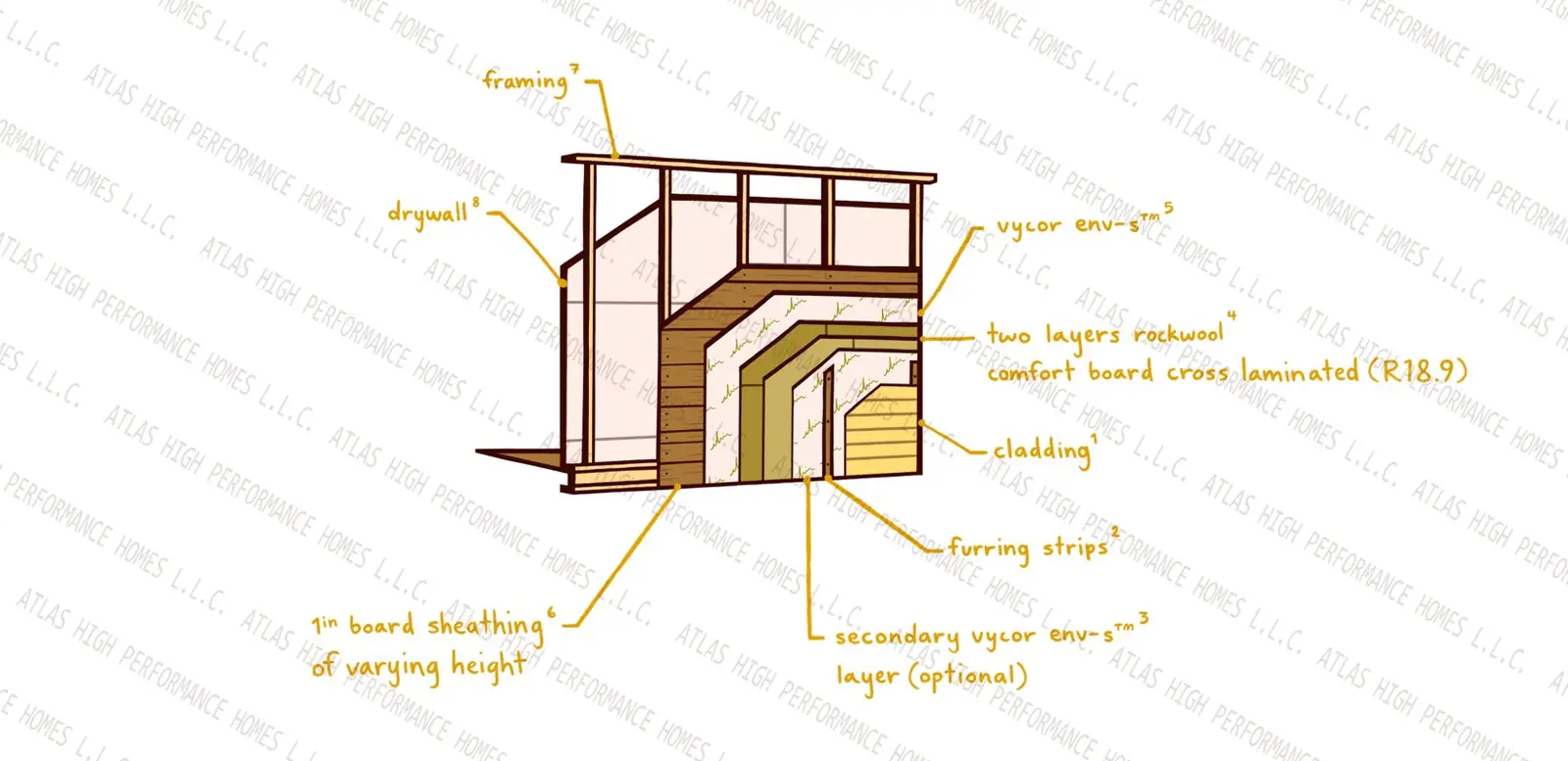
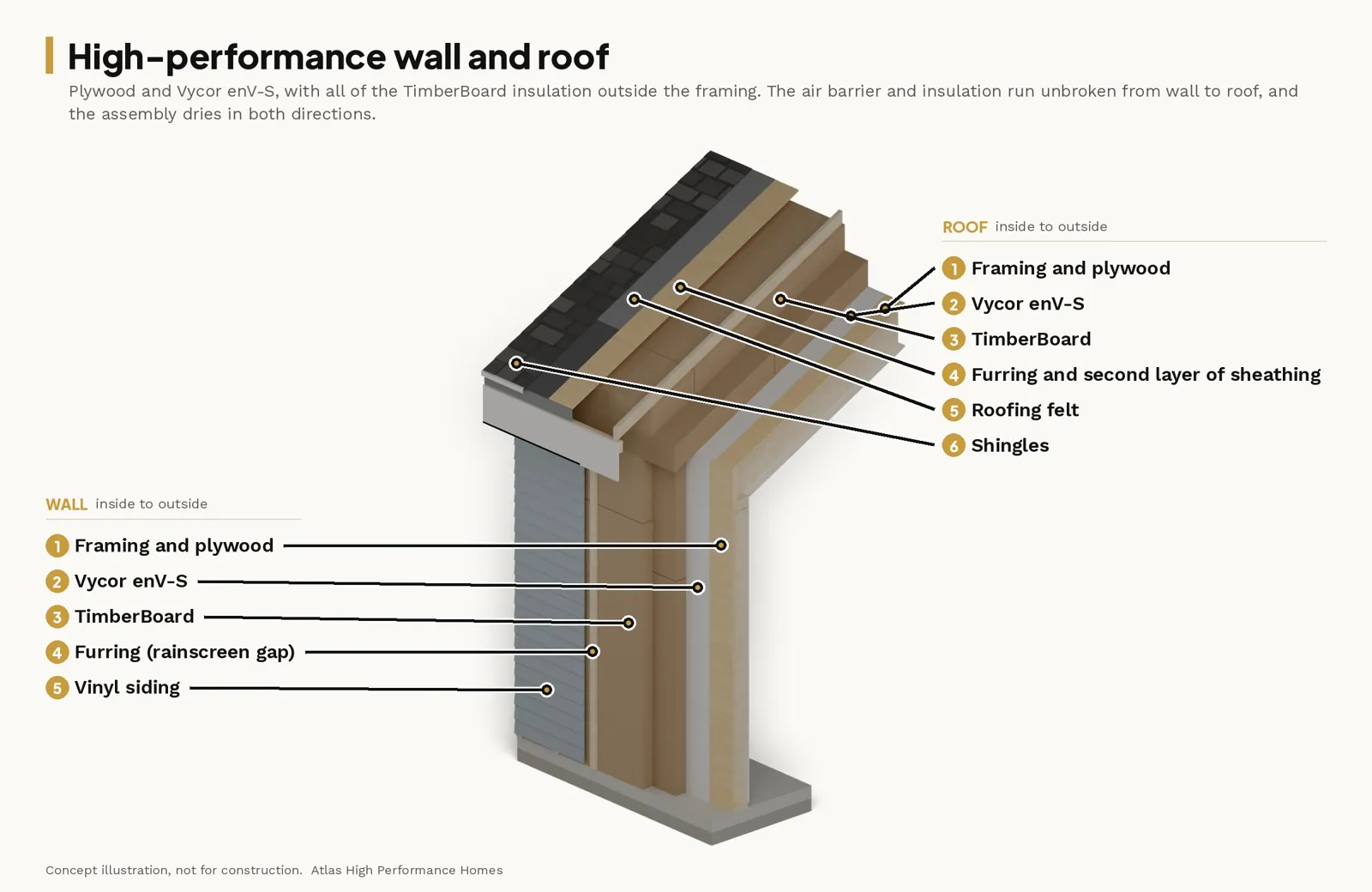
7. Build the roof to stay cold when it is replaced. Vaulted ceilings have no attic to vent, so the air barrier and insulation work best above the deck. The guide calls a vented over-roof the "most successful approach" for ice dams in high snow load areas (p. 219). Our high-performance roofs use a plywood deck, Vycor enV-S as the air barrier, TimberBoard wood-fiber insulation, and furring under a second layer of sheathing for the vented space, then felt and shingles. If some insulation stays under the deck, the guide's Table 7.1 calls for at least R-30 of the R-60 total above the deck in zone 6, and R-25 in zone 5. I compare costs in High-Performance vs. Standard Construction and cover metal roofs in Why Your Standing-Seam Metal Roof Still Ice-Dammed.
Note: After air sealing, have fuel-burning appliances checked; the guide states that "spillage or backdrafting of combustion appliances is unacceptable" (p. 409).
Next Step
Reach out if ice dams formed on your roof last winter and you want to find out where the heat is coming from!
Atlas High Performance Homes
Phone: (603) 688-6096
Email: AtlasRemodelingNH@gmail.com
Sources
- Lstiburek, J. Builder's Guide to Cold Climates. Building Science Corporation, 2022, pp. 42, 219, 231 (Table 7.1), 409, 433.
- Lstiburek, J. BSI-046: Dam Ice Dam. Building Science Corporation, 2011.
- Lstiburek, J. BSD-102: Understanding Attic Ventilation. Building Science Corporation, 2006.
- Straube, J. BSD-135: Ice Dams. Building Science Corporation, 2006.
- Building America Solution Center (U.S. DOE / PNNL). Construct Roofs and Attics for Ice Dam Prevention.
- University of Minnesota Extension. Dealing with and preventing ice dams. Reviewed 2022.
- Minnesota Department of Commerce. Got ice dams? Learn what to do and how to prevent them. 2019.
- International Code Council. 2018 International Energy Conservation Code, Table R402.1.2; 2024 International Residential Code, Section R905.1.2.